
How to Object to a Planning Application in the UK: A Complete Guide & Objection Letter Tips
Introduction: Why the Planning System Feels Stacked Against Objectors
If you’ve ever tried to object to a planning application in the UK, you’ll know it can feel like the odds are stacked against you. The UK planning system is heavily geared toward achieving ambitious government housebuilding targets — 1.5 million homes this Parliament — and new policies such as ‘grey belt’ land reclassification are making it easier to approve developments on previously protected sites.
Local planning authorities (LPAs) face enormous pressure to meet housing delivery goals, while applicants and developers often have the resources, consultants, and insider knowledge to navigate the system effectively. The result?
Around 500,000 planning applications are submitted each year across the UK.
Roughly 79% are approved.
Many local residents feel powerless in the face of overdevelopment.
But you can level the playing field. With the right knowledge of the planning objection process UK, understanding valid reasons to object to a planning application, and knowing how to produce a strong planning objection letter, you can make your voice count.
This guide from Objector explains each stage of the process, highlights legitimate grounds for objection, and includes tips to help you craft a professional, persuasive response.
The Planning Objection Process UK: Step-by-Step
Knowing how the planning application process works is the first step to making your objection effective. The process varies slightly in each UK country, but the below provides a broad overview, applicable to all UK countries.
Stage 1: Application Submission and Validation
A developer or homeowner submits a planning application to their local council. The council validates it (checks it’s complete) before it’s published online.
Stage 2: Public Consultation Period
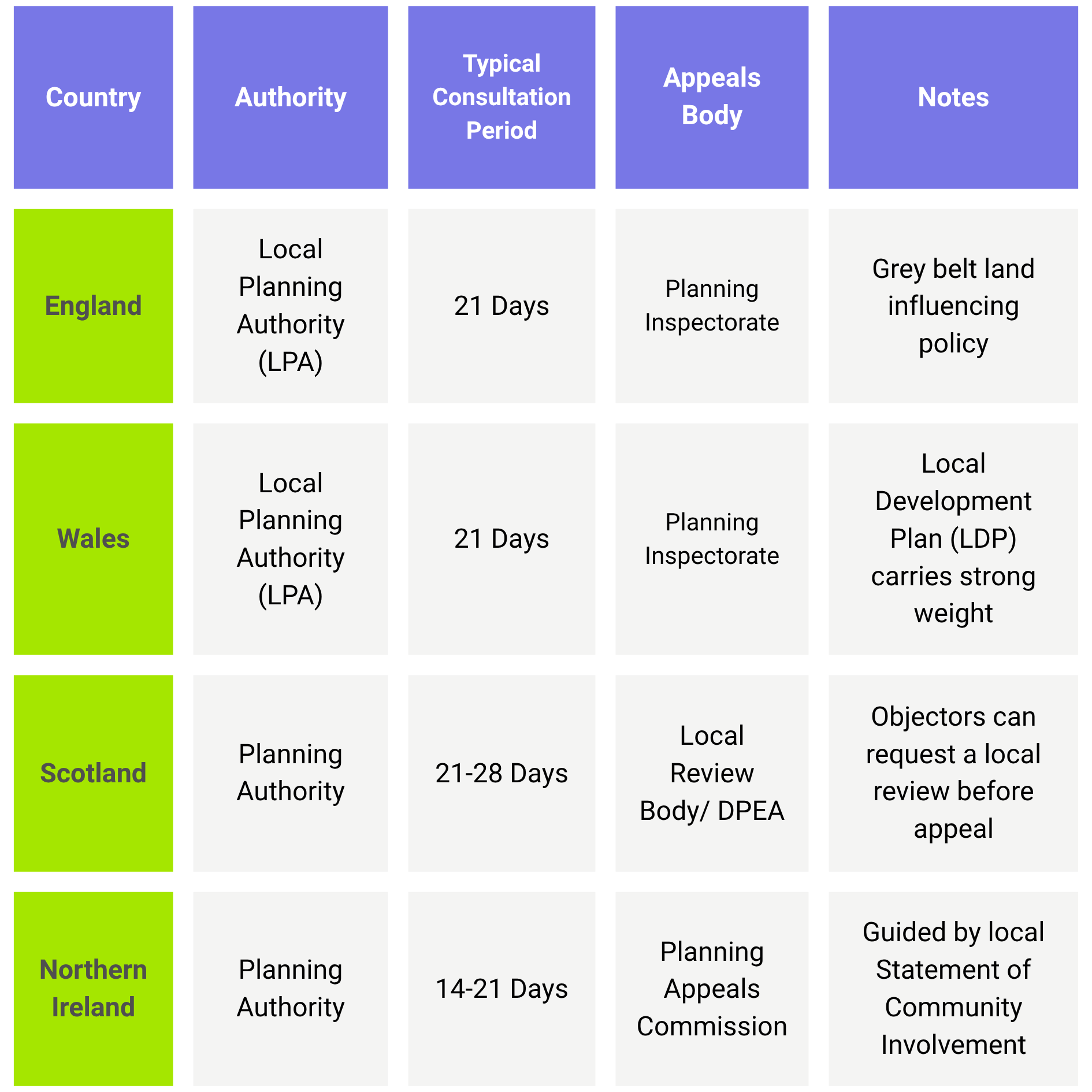
Once validated, the planning application consultation period begins — usually 21 days in England and Wales, 21-28 days in Scotland and 14-21 days in Northern Ireland.
During this window, anyone can object to planning permission by submitting a written planning objection letter to the LPA. Councils notify nearby residents via:
Neighbour letters
Site notices
Press adverts
Online registers
If you miss the consultation period, some LPAs still accept late comments before a decision is made.
💡PRO TIP: Upload the applicant’s planning documents to Objector, and our specially trained dual AI will generate a tailored planning objection letter, including policy references, in minutes. Check all details thoroughly, and add any local knowledge that relates to the material objection grounds found.
Stage 3: Case Officer Review
A planning officer reviews the application, considers the material planning considerations, and writes a report recommending approval or refusal.
Stage 4: Decision — By Planning Officer or Committee
Most minor applications are decided by planning officers under delegated powers. In England, Wales and occasionally Scotland, larger or controversial cases go to a planning committee, where councillors debate the application publicly.
This is where councillor lobbying becomes important - contacting your local councillor to make them aware of the application and your grounds for objection. It’s important to contact them as early as possible to allow them time to review your input, ahead of a planning committee meeting.
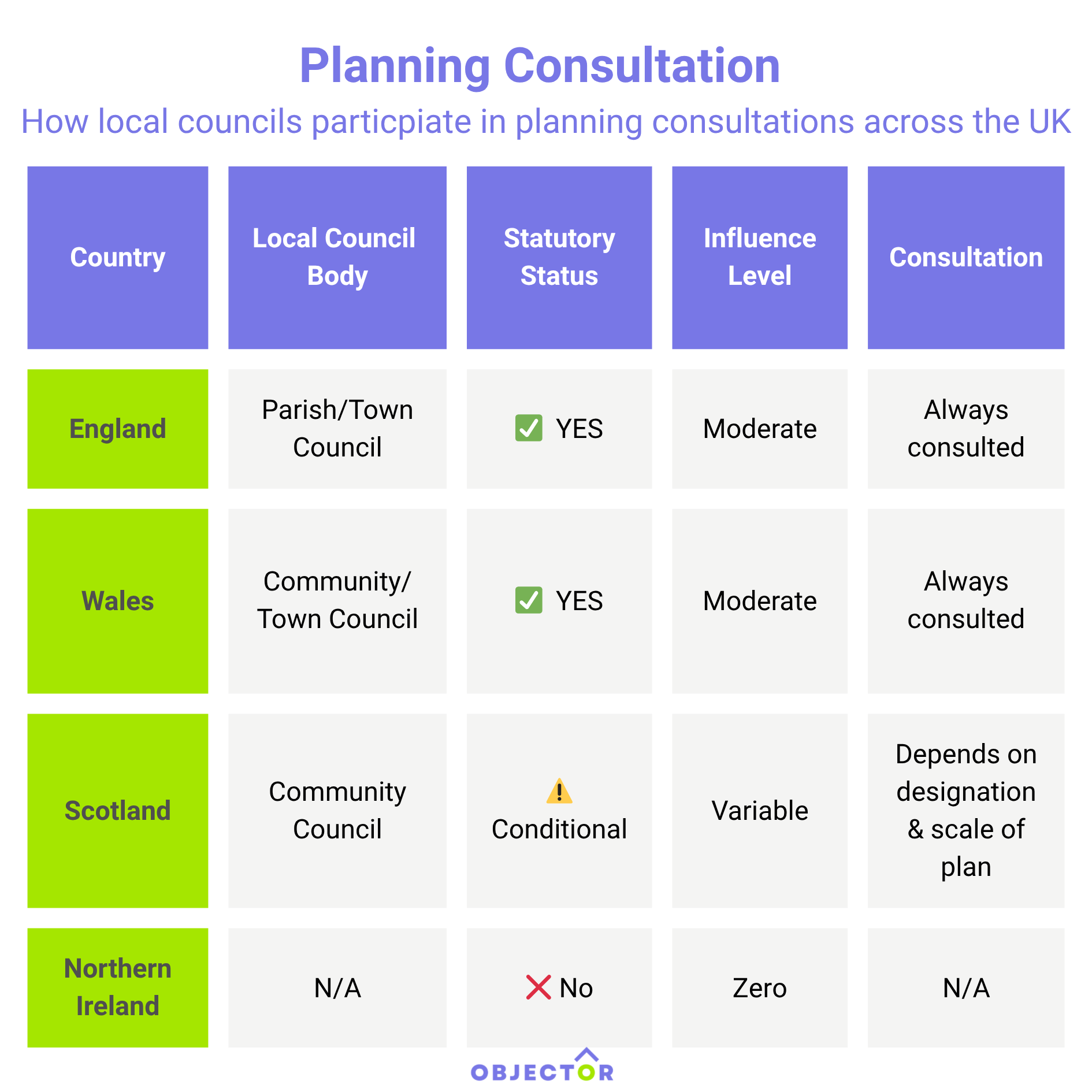
In some councils, you can request to speak — search your council’s ‘planning committee speaking rules’. This is a great forum to personally present your objection grounds, or those of your local community.
💡 PRO TIP: Objector will create a tailored lobbying letter and video to send to your local councillor(s), and a speech for you to present at a committee meeting (tailored to the permitted time limit for your council). All materials will succinctly outline the valid planning objection grounds and cite local policy references. You choose which objection grounds to include, based on the ones you believe will resonate best with the councillor(s).
Stage 5: Decision Notice & Appeals
The council issues a decision. If approved, permission is granted (often with conditions). If refused, the applicant can appeal through the planning appeals process UK, reviewed by the Planning Inspectorate (England and Wales), the Directorate for Planning and Environmental Appeals (Scotland), or the Planning Appeals Commission (Northern Ireland).
Note: Objectors themselves generally cannot appeal a planning decision — but they can submit further representations during the appeal or challenge serious procedural errors through judicial review.
Objection Process by Country
Valid Reasons to Object to a Planning Application (Material Planning Considerations)
When you object to a planning application, focus only on material planning considerations — the legal grounds councils must take into account. Emotional or personal arguments rarely carry weight.
The list below is illustrative, not exhaustive. Whether something is a material planning consideration depends on the development and local/national policy — always check the relevant Local Plan, NPPF (or Welsh/Scottish equivalents), and local authority guidance.
✅ Valid Grounds for Planning Objection - All UK Countries
Highway Safety & Traffic Impact – Creates danger or congestion on local roads.
Inadequate Parking Provision – Not enough on-site parking for residents or visitors.
Overdevelopment of Site – Too dense; harms character or neighbouring amenity.
Loss of Residential Amenity – Reduces light, privacy, or enjoyment of homes.
Noise & Disturbance – Causes unacceptable disruption to nearby occupants.
Visual Impact & Design – Poor design harms streetscape or surrounding appearance.
Impact on Local Character – Conflicts with established scale, form, or setting.
Heritage & Conservation – Damages listed buildings or conservation area character.
Environmental Impact – Increases pollution or harms natural surroundings.
Biodiversity & Ecology – Threatens habitats or protected species on site.
Flooding & Drainage – Increases surface water or flood-risk potential.
Infrastructure Capacity – Strains local schools, healthcare, or utility services.
Policy Non-Compliance – Conflicts with Local Plan or national policy.
Public Health & Safety – Endangers wellbeing through hazards or unsafe design.
Air Quality Impact – Worsens local air pollution or emissions levels.
Landscape & Green Belt – Harms countryside views or breaches green belt policy.
Procedural Compliance – Fails to meet statutory consultation or process requirements.
Equalities Impact - Fails to consider or accommodate the needs of people with protected characteristics under the Equality Act 2010.
Wales only
Welsh Language Impact - Likely to undermine the use or sustainability of the Welsh language
Scotland
Community Impact Assessment - Doesn’t adequately consider the community impact required under Scottish planning policy. Scotland has specific guidance on community impact and engagement; similar assessments may be required or considered in England and Wales, depending on local policy and the nature of the development.
🚫 Invalid Grounds for Planning Objection (Will Be Ignored)
“Personal circumstances – “I just don’t want this near me.”
Property values – “It will reduce my house price.”
Loss of view – “It blocks my view.”
Competition with existing businesses – “It will hurt my business.”
Moral objections – “I don’t like the type of development.”
Focus your planning objection letter on valid, evidence-based planning grounds — not emotion or speculation.
How to Write a Strong Planning Objection Letter
A well-structured planning objection letter is your best tool for being heard. Follow the tips below or generate one automatically using Objector’s planning objection toolkit (better than an objection letter template - Objector writes the letter for you).
Tips for Writing an Effective Objection Letter
Ensure your letter is unique — copy-paste letters carry less weight.
Focus on material planning considerations rather than personal opinions.
Reference planning policy numbers where possible.
Submit before the consultation deadline.
Stay polite, factual, and specific.
Appeals and How to Challenge a Planning Decision
If your objection doesn’t succeed and permission is granted, there are still routes to pursue:
Planning Appeals Process UK – Developers can appeal a refusal; objectors can submit further comments to the Planning Inspectorate or devolved appeals body.
Judicial Review – If there has been a serious procedural error or illegality, objectors may apply for a judicial review within six weeks.
Planning Enforcement Objections – If development proceeds without permission or breaches conditions, contact your council’s planning enforcement team.
Planning Statistics: Why Objections Matter
Around 500,000 planning applications are submitted in the UK each year.
Average approval rate: ≈ 79 %.
Average decision time: 117 days.
Grey belt land planning changes could increase the number of approvals on previously protected sites.
Despite these odds, well-reasoned planning objections can influence officer reports, trigger design changes, or lead to refusal — especially when tied to local plan conflicts or highways and amenity impacts.
Conclusion: Use Objector to Strengthen Your Case
The UK planning system may favour applicants, but it is not beyond challenge. By understanding the planning objection process UK, identifying valid reasons to object to a planning application, and presenting them effectively, you can present a robust case for rejection (or adaptation).
Objector is the UK’s first AI-powered platform that empowers individuals and communities with the tools and expertise to challenge property planning applications. We level the playing field, making the objection process faster, smarter, and more effective - without paying thousands in consultancy fees.
Objector creates a complete planning objection toolkit by analysing planning documents to find valid objection grounds, backed by policy references, creating a planning objection letter, a councillor lobbying letter and video, along with a ready-to-present planning committee speech.
Use this guide as your foundation, then let Objector do the heavy lifting, so your voice carries real weight in the UK’s planning system.