Specialist AI vs Generic AI: Which Actually Works for Planning Objections?
We benchmarked Objector against generic AI using real UK planning applications. Discover why accuracy matters — and why generic AI misses 1 in 3 critical issues.
AI tools are increasingly being used to generate planning objections. From homeowners to planning consultants, the appeal is obvious — faster analysis, lower cost, and instant outputs.
But there’s a critical question - Do these tools identify the issues that actually influence planning decisions?
To answer this, we benchmarked Objector — a specialist AI built for the UK planning system — against generic AI tools using real planning applications and officer reports.
The results highlight a clear gap in performance — especially where it matters most.
Benchmarking AI Against Real Planning Decisions
Most AI comparisons rely on:
synthetic prompts
subjective scoring
or simplified test cases
This benchmark uses a different approach.
Each tool was tested against real planning applications and evaluated against the grounds identified by planning officers in official reports.
This means the test measures:
decision relevance
policy accuracy
technical understanding
—not just whether the output “sounds right.”
Key Results
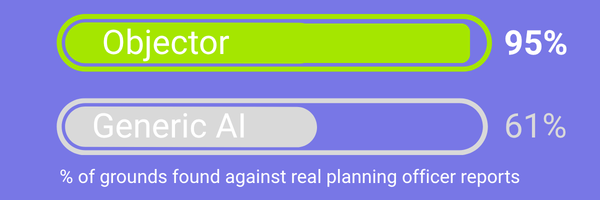
A 34% point accuracy gap
Objector identified 35 of 36 decision-making grounds
Generic AI identified 25 of 36
Generic AI missed 1 in 3 material objection grounds
Scope: Tested against 7 real planning applications across all 4 UK jurisdictions
Why Generic AI Falls Short in Planning
Generic AI models are designed to be broad and flexible. They can summarise documents and raise general concerns — but planning decisions require more than that.
A valid planning objection must:
reference specific policy
apply the correct legal framework
identify technical deficiencies
In this benchmark, generic AI consistently underperformed in these areas.
Where Generic AI Struggles
Generic AI was weakest in:
Heritage and statutory duties
Noise assessment methodology (e.g. BS4142)
Biodiversity and ecology requirements
Jurisdiction-specific policy frameworks
These are often the most critical factors in planning decisions
A Better Alternative to Mass-Generated Objections
One of the unintended consequences of generic AI is the rise of mass-produced planning objections.
It’s now possible to generate hundreds of near-identical letters in minutes. While this may feel like strengthening opposition, in practice it can have the opposite effect.
Planning officers are required to assess:
material planning considerations
not the number of submissions
Large volumes of repetitive or low-quality objections can:
add administrative burden
dilute stronger, evidence-based points
reduce the overall effectiveness of submissions
In planning, quality carries more weight than quantity
Pooling Resources: A More Effective Approach
Instead of flooding the system with duplicated objections, Objector supports a different model:
Crowdfunded, policy-backed objections built by the community
This approach allows individuals to:
contribute to a single, high-quality objection
ensure it is professionally structured and policy-based
avoid duplication and inconsistency
By pooling resources, communities can:
focus effort where it matters
produce stronger, more credible submissions
reduce noise in the planning process
The Difference: General Concerns vs Decision-Grade Grounds
One of the clearest findings was the difference between:
general observations
and policy-backed planning grounds
For example:
Generic AI might say:
“The development could impact nearby residents due to noise.”A valid planning ground requires:
reference to specific standards
identification of missing methodology
linkage to policy requirements
Planning decisions are based on evidence and policy — not general concerns
The Real Gap
Generic AI misses 1 in 3 critical planning issues
Even when it raises relevant topics, it often fails to:
apply the correct policy
assess technical compliance
identify decision-level issues
Why Specialist AI Performs Better
Objector is not a general-purpose model. It uses three advanced AI models and cross-validates the findings to ensure greater accuracy. It has been trained specifically on UK planning policy and developed in partnership with parish councils.
It is built specifically for the planning system using:
jurisdiction-aware policy frameworks
structured ground identification
specialist evaluation models
These include analysis of:
transport and highways
noise and amenity
ecology and biodiversity
flood risk and drainage
This allows it to identify not just what might be wrong, but what matters in a planning decision
Why This Matters for Planning Objections
Submitting a planning objection is not just about raising concerns.
It’s about:
identifying material planning considerations
aligning with policy and guidance
presenting issues in a way that decision-makers must consider
Missing key grounds can mean:
weaker objections
reduced credibility
or no impact on the outcome
Can Generic AI Still Be Useful?
Yes — but with limitations.
Generic AI can help with:
summarising documents
drafting initial text
highlighting obvious issues
However, it should not be relied on for:
identifying all relevant planning grounds
applying policy correctly
evaluating technical reports
Conclusion: When Accuracy Matters, Specialisation Wins
AI is transforming how planning objections are created.
But not all AI is equal.
Planning decisions depend on precise, policy-backed reasoning — not generalised outputs.
This benchmark shows that specialist AI significantly outperforms generic tools when evaluated against real-world decisions.
For users submitting planning objections, that difference can be critical.