Object to a new housing development
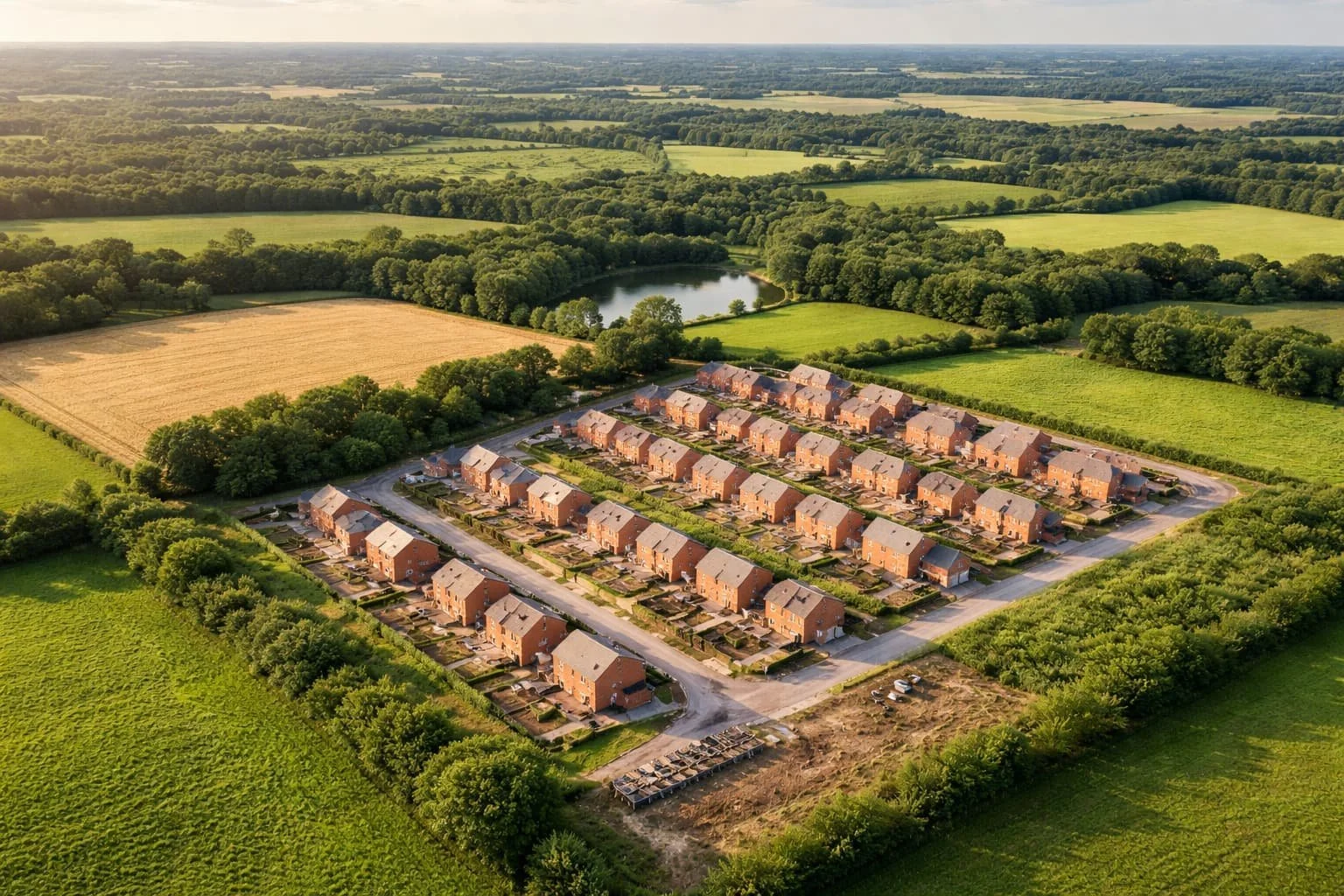
What is an Outline Planning Application?
An Outline Planning Application asks whether a development is acceptable in principle, without providing full details.
It is usually submitted for larger or more complex projects where the developer wants to confirm that the site is suitable before finalising designs.
Why Outline Applications Matter
Outline applications are one of the most important stages in the planning process.
If approved, they set the direction for development — making it much harder to challenge the scheme later when details are submitted.
By the time a full (or ‘reserved matters’) application is made, the principle of development is usually already accepted.
In short: if an Outline Application is a threat to your community and you want to object, this is the stage where it matters most.
Typical Outline Planning Applications
✔️ Large Residential: housing estates, apartments, student or affordable housing
✔️ Mixed-use: housing combined with shops, offices, or leisure facilities
✔️ Commercial/Industrial: offices, warehouses, factories, business parks
✔️ Community/Public: schools, health centres, gyms, sports facilities
✔️ Infrastructure/Utilities: roads, bridges, transport hubs, energy or water projects
✔️ Large Redevelopment Sites: town centre or mixed-use regeneration schemes
“Objector offers accessible, community-driven tools at an affordable cost for the community. It has saved our committee months of time, & customer service is second to none.
I am blown away by the amount of data it has successfully analysed and cannot recommend it more highly. Thank you!!”
— Gayle Buckley, Committee Chair, NO to South Hindley Masterplan
❌ Why It’s Difficult to Object
Fed up with wading through complex documents?
⛌ Documents are often long, technical, and fragmented
⛌ Key information is spread across multiple reports
⛌ Wading through documents can take hundreds of hours
⛌ Planning policies are complex and hard to interpret
⛌Generic AI is often inaccurate and can’t handle the large document sizes
At the same time, applicants are supported by professional consultants and planning experts, which are often out of reach for individuals and communities.
✅ How Objector Can Help
We do the heavy-lifting for you.
✔️ Check your valid material objection grounds for free
✔️ Generate a professional, structured objection letter & toolkit with full policy references (from the National Planning Policy Framework and local plans)
✔️ Results validated across three advanced AI models for greater accuracy
✔️ Bring your community together to fund one strong, unified response
All without paying thousands in consultancy fees - it’s just £249 for your objection letter and toolkit, which your community can raise together with our unique crowdfunding feature.
How It Works
-

1. UPLOAD APPLICATION DOCUMENTS & LOCAL PLAN
Find these on your local council’s planning portal by entering the planning application number, & upload all relevant documents from the applicant, along with your Local Development Plan.
-

2. CHECK VALID OBJECTION GROUNDS FOR FREE
Find out if there are valid objection grounds & view their impact ranking of high, medium or low. If there are no valid grounds, we’ll advise you not to continue, and you won’t pay a penny.
-

3. CROWDFUND YOUR OBJECTION TOOLKIT
Use our (optional) crowdfunding feature to invite your community to raise £249 to unlock your professional objection toolkit, pooling your resources to create a strong, united voice.
-

4. GENERATE OBJECTION LETTER & TOOLKIT
Pay just £249 to generate your complete planning objection toolkit, including an objection letter, lobbying letter/video, & planning committee speech - all with planning policy references.
Stronger Together

Crowdfund Your Objection Toolkit - Just £249
Submitting hundreds of identical objections doesn’t strengthen your case — and can slow down the planning process.
What matters is quality, not quantity.
Objector helps you bring your community together with our unique crowdfunding feature to share the cost and submit one clear, well-argued, policy-based objection — a response that carries more weight with planning officers and avoids unnecessary duplication.
Turn shared concern into a single, united voice that gets taken seriously.
Your Planning Objection Toolkit
The tools you need to object to an Outline Planning Application — powered by multi-model AI, grounded in planning policy, and fully editable so you can add your own local insight and evidence.
-

OBJECTION GROUNDS REPORT
We identify the valid objection grounds for your application and rank them by impact, so you can prioritise the issues most likely to influence the planning authority. Check if we find valid grounds for FREE.
-
OBJECTION LETTER
Create an AI-powered planning objection letter in minutes. Tailored to your key grounds, aligned with national and local rules, and backed by specific policy references for maximum impact.
-

COUNCILLOR LOBBYING VIDEO
Cut through the sea of paperwork with a bold, innovative briefing video. Include the objections you think will resonate most, and influence councillors ahead of a potential planning committee.
-

COUNCILLOR LOBBYING LETTER
Download a ready-to-send letter for local councillors that clearly presents your key planning objections. Make a compelling case with maximum impact and gain support ahead of a potential planning committee.
-

PLANNING COMMITTEE SPEECH
Get a structured, ready-to-deliver speech, tailored to the permitted time limit for your council. Command attention at planning committee meetings and present your case with confidence and clarity.
-

AI PLANNING POLICY ADVISOR
Don’t understand why an objection is valid? Ask our AI Planning Policy Advisor to explain objection grounds and cited policies in simple language. Then, email the discussion to your inbox for your records.
How to Tell if it’s an Outline Planning Application
If the application is for a large development and doesn’t include detailed building plans, elevations, or layouts, it’s probably an outline application.
An Outline Planning Application usually:
✔️ Confirms what type of development is proposed (e.g. housing, mixed-use, etc.)
✔️ Leaves key details such as design, layout & scale for later approval (known as ‘Reserved Matters’)
✔️ If approved, requires the developer to submit Reserved Matters applications to get detailed plans formally approved
Check the application type on the council’s planning portal and look for:
✔️ Wording such as ‘Outline Planning Permission’, ‘Outline Application’, or ‘Proposed Development in Principle’
✔️ It may also say ‘all matters reserved’or list which details are reserved
✔️ No detailed plans - Outline Applications do not include full designs, layouts, or elevations
If you can see exact designs, elevations or floor plans it’s more likely to be a Full Planning Application.