How to Harness the Power of AI for Planning Objections in 2026
Spring marks the start of a busy planning season. Across the UK, homeowners are preparing loft conversions, rear extensions and redevelopment projects, and for neighbours, that often means facing unsuitable planning applications that could negatively impact their homes and communities.
If you’ve ever tried to object to a planning application, you’ll know how daunting the process can feel. Planning policy is complex, technical and time-consuming to interpret. Professional planning consultants and lawyers can cost thousands of pounds, putting effective objections out of reach for many residents.
But there is a better way.
Thanks to specialist AI-powered planning tools, residents now have a practical, affordable way to object to planning applications clearly, effectively and with confidence.
Why Planning Objections Often Fall Flat
Every UK resident has the right to object to a planning application, but not all objections are treated equally.
Common reasons objections fail include:
Focusing on non-material considerations
Submitting emotional or generic arguments
Misinterpreting national or local planning policy
Poor structure or lack of evidence
Not understanding what planning officers are legally required to consider
Time constraints, meaning residents miss the deadline to object
The result? Most planning objections carry little weight in the final decision.
How AI Is Transforming the Planning Objection Process
AI technology is now reshaping how people engage with the planning system, providing access to tools that help them participate more fairly in the planning process.
With credible AI planning objection tools, residents can now easily and affordably:
Analyse applications against UK national and local planning policy in minutes
Identify valid, material grounds for objection without spending days/weeks wading through policy
Produce clear, structured, policy-backed submissions
Engage effectively without hiring expensive consultants
Access a full planning objection toolkit, including a planning objection letter, lobbying materials and planning committee speech.
Does AI Make Mistakes? A Transparent Answer
Yes, AI can make mistakes, and we’re very open about that. But it’s important to recognise that people make mistakes too - particularly when interpreting complex planning policy with no assistance or prior experience.
Planning is complex. Everyone involved - applicants, planning officers, consultants and residents - can and do get things wrong. Credible AI reduces that margin of error by giving people a stronger, more informed starting point.
In practice, Objector improves accuracy by helping residents:
Focus on material planning grounds
Avoid irrelevant or emotional objections
Structure arguments logically
Replace assumptions with policy-based evidence
Unlike general AI tools that rely on a single model, Objector uses a three-layer AI system designed to deliver more accurate and reliable results. Each model reviews the planning application and policy context independently, enabling the platform to cross-check conclusions, surface valid objection grounds that might otherwise be missed, and prioritise the arguments most likely to influence the planning decision.
AI Supports Human Judgment — Not Replaces It
AI is not designed to bypass human judgment. It’s designed to support it. We actively encourage every user to review AI-generated objection materials carefully and add relevant local context and lived experience to support the material objection grounds found.
For example, if AI identifies that you have a valid objection ground of Highway Safety & Traffic Impact, which creates danger or congestion on local roads, you may be able to support this with further information on parking pressure.
Perhaps you know a local nursery will soon change its opening times or capacity, exacerbating the issues. Or perhaps a village hall will start hosting the local Scouts group, requiring additional parking on certain evenings. This is all local knowledge that AI can’t identify, which you can add to help support the objection and refine arguments based on neighbourhood insight. AI provides the structure and policy grounding; you provide the reality on the ground.
Generic AI vs Specialist AI - ‘Can’t I just use ChatGPT?’
“You can use a general AI tool to write a planning objection, but it’s a bit like asking Dr Google for a diagnosis - you’ll get an answer, but it probably won’t be the right one.”
General-purpose AI isn’t designed for the realities of the UK planning system. Producing a usable objection often involves hours of prompting, reformatting, and manual checking, with no guarantee that the arguments raised are actually material planning considerations.
Most generic AI tools rely on a single model, aren’t trained specifically on UK planning policy, don’t rank objection grounds by impact, and typically produce basic text that still needs significant work before it’s ready to submit.
Objector is different because it’s purpose-built for UK planning objections. It uses a three-model AI system trained on planning policy and local plans to cross-validate findings, identify valid objection grounds a single model can miss or misinterpret, and rank them based on their real-world planning impact.
The platform doesn’t just generate text — it provides a complete objection toolkit, including policy-cited planning objection letters, councillor lobbying letters and videos, and committee speeches. Most importantly, Objector is designed to help residents engage properly with the planning process, saving time, reducing uncertainty, and improving the quality of objections — not just making them faster to write.
The other issue with generic AI is the large file sizes associated with planning applications. To generate a full and accurate planning objection, you need to upload all the documents submitted to the council’s planning portal by the applicant - not just some of them. Applications often include a huge number of large documents, which will far exceed the limits allowed by free AI platforms.
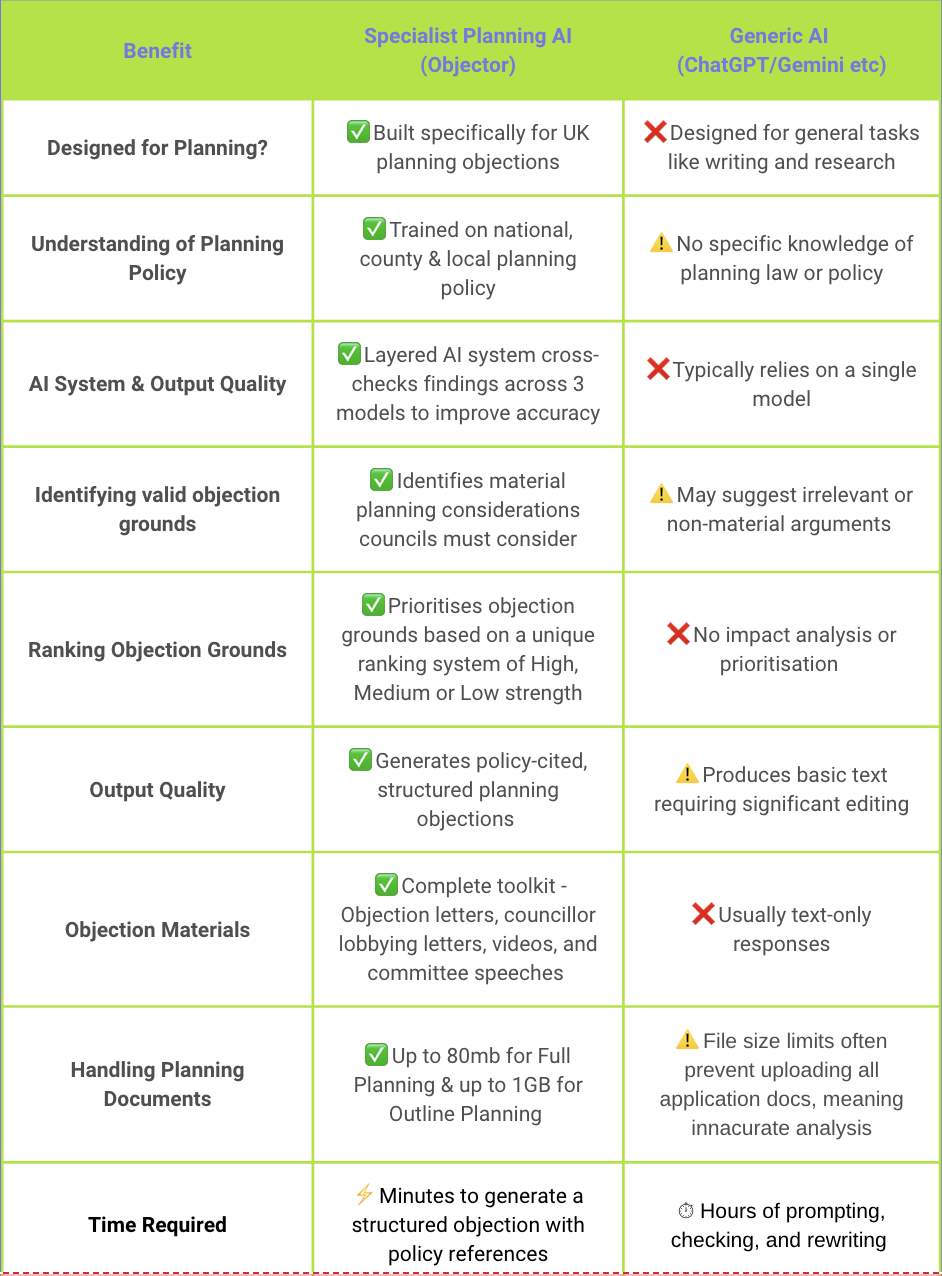
Generic AI vs Specialist Planning AI
Why tools like Objector outperform general AI for planning objections
Affordable Planning Objections Without Costly Consultants
Traditionally, producing a strong planning objection meant spending thousands on professional advice.
AI changes that. Objector makes planning objections:
Affordable
Accessible
Comprehensive
Evidence-based
This isn’t about stopping development for the sake of it. It’s about fair participation in unfair or unsuitable applications, where material objection grounds exist that stand to negatively affect homes, streets and communities.
A Smarter Way to Object
AI is making it easier for residents to engage meaningfully with the planning system. By saving time, reducing costs and helping people understand complex planning policy, AI-powered tools give residents access to the kind of structured, policy-led analysis that was once only available through expensive professional advice. Used properly, AI helps focus objections on valid, material planning considerations, resulting in clearer, more relevant submissions that support better decision-making.
However, not all AI is created equal when it comes to planning. Because planning decisions depend on credibility, evidence and policy context, it’s important to use tools designed specifically for the UK planning system. Choosing a specialist platform like Objector — and taking the time to review outputs and add relevant local knowledge — helps ensure objections are well-founded, informed and constructive. When used responsibly, AI doesn’t undermine the planning process; it helps people participate in it more confidently and effectively.
Harness the Power of Layered AI Intelligence
Objector is the UK’s first multi-model AI-powered platform that empowers individuals and communities with the tools and expertise to challenge property planning applications. We level the playing field, making the objection process faster, smarter, and more effective - without paying thousands in consultancy fees.
Objector creates a complete planning objection toolkit by analysing planning documents to find valid objection grounds, backed by policy references, creating a planning objection letter, a councillor lobbying letter and video, along with a ready-to-present planning committee speech.